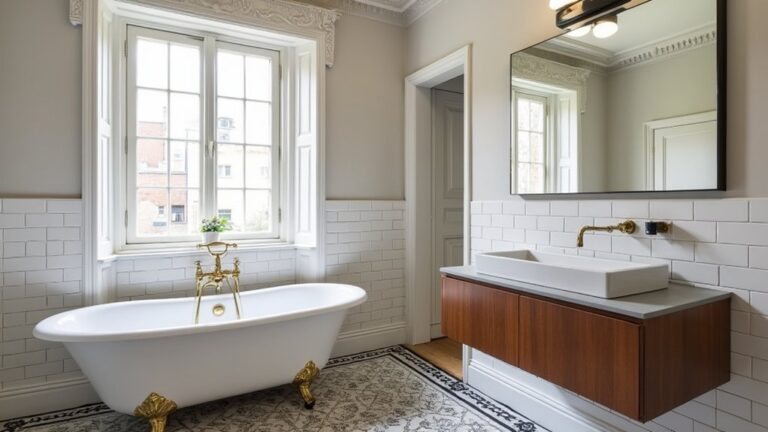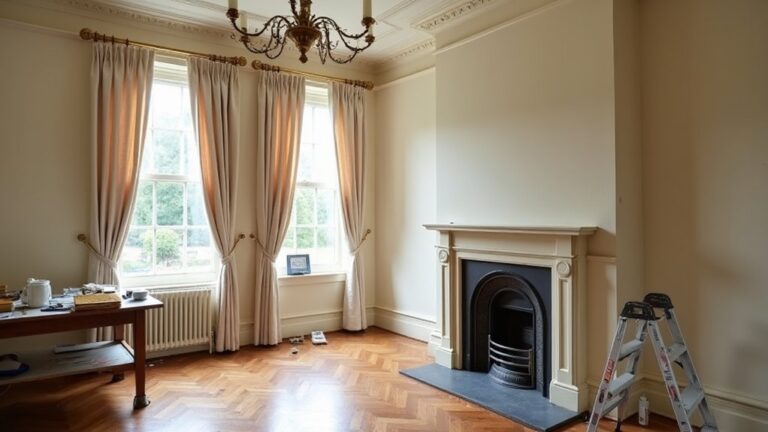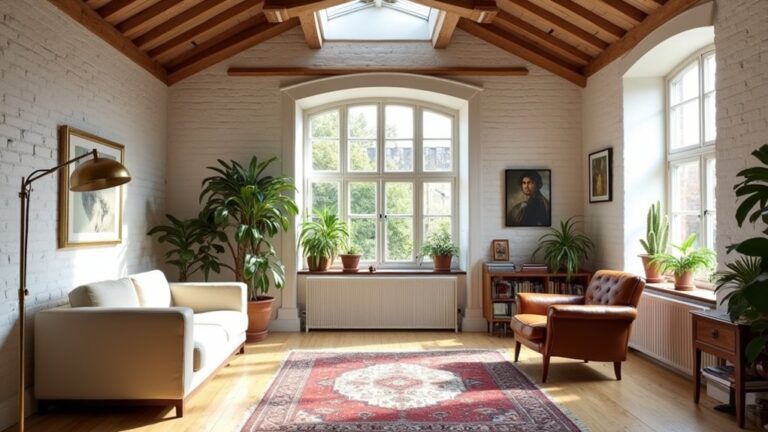
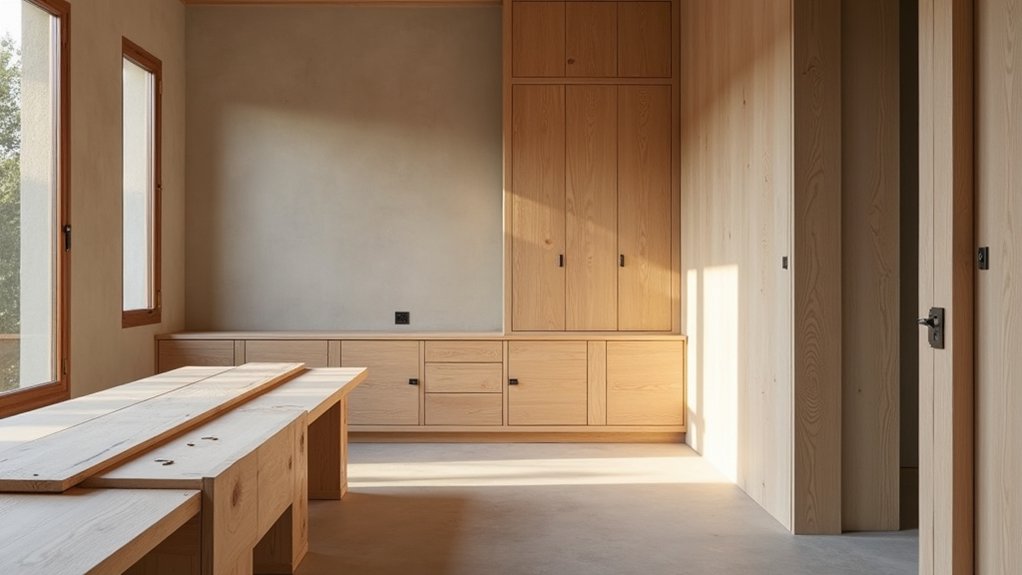
You can blend modern restraint with traditional joinery by starting with a clear style reference, then deciding where the craftsmanship earns visibility—entry cabinetry, a feature wall, or a kitchen run. You’ll keep the look sharp by choosing clean joinery types, disciplined rail and reveal proportions, and quiet shadow lines instead of rustic cues. Material and hardware choices matter as much as tolerances for wood movement—because one detail will either elevate the whole room or expose every compromise…
Key Takeaways
- Choose a modern style reference and build a coherent palette: two core materials, one metal, one textile, tested under evening light.
- Specify light, quiet-grain, sustainable timber with matte finishes to prevent ambering and maintain a modern-traditional surface balance.
- Map sightlines and place visible joinery only where it matters—entry, kitchen, sofa zone—keeping secondary areas quieter with reveals and shadow gaps.
- Use restrained, geometric joinery and panel types—slim tenons, tight dovetails, micro-shaker, crisp frame-and-panel—with consistent rail/stile proportions.
- Standardize reveals and hardware alignment—2–3 mm gaps, consistent backsets, matte metal finishes—while accounting for finish buildup and seasonal wood movement.
Choose Your Modern Interior Style Reference
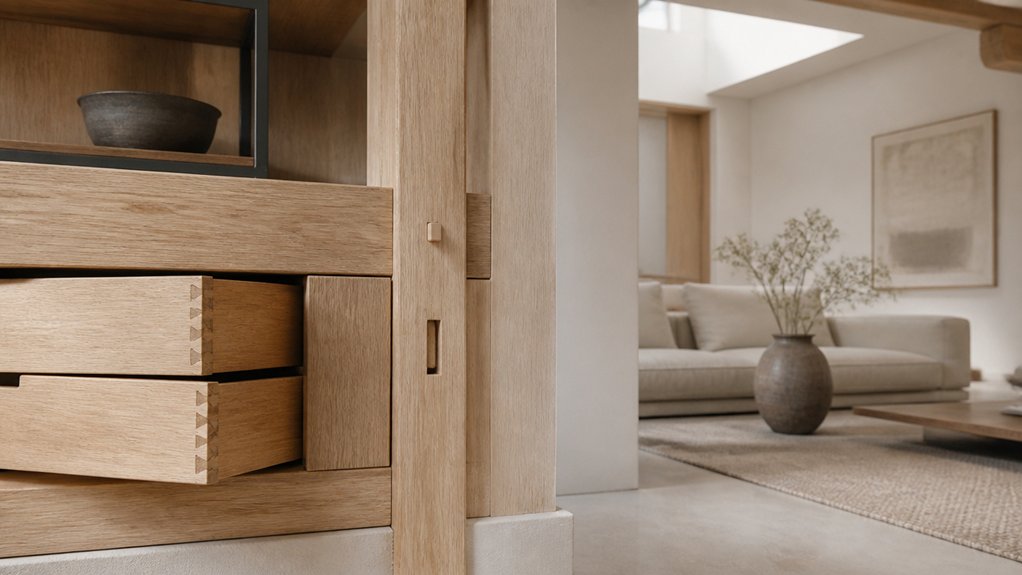
Before you start specifying timber profiles or panel details, decide which modern interior style you’re actually referencing, because “modern” can mean anything from warm minimalism to industrial loft.
Choose one reference set—Japandi calm, mid‑century clarity, contemporary Scandinavian, or refined industrial—and stick to its rules on proportion, negative space, and surface sheen.
Track Cultural influences: Japanese restraint, Danish craftsmanship, Italian rationalism, or New York warehouse grit.
Then map the Historical context: Bauhaus functionalism, postwar optimism, or 1970s brutalist honesty.
Build a tight palette—two core materials, one accent metal, one textile—so traditional joinery reads intentional, not nostalgic.
Test your choice with lighting temperature and shadow lines; your selected style should still feel coherent at dusk.
Decide Where Joinery Will Show Up
With your modern reference locked in, you can now decide where traditional joinery belongs so it reads as a deliberate detail, not a period quote. Start by mapping sightlines: what you see from the entry, sofa, and kitchen work zone should carry the craft.
Use Traditional joinery where hands land—door pulls, drawer fronts, stair rails, bench edges—so the precision feels purposeful. Reserve higher-visibility moments for statement pieces: a built-in media wall, a window seat surround, a freestanding cabinet, or a slim room divider.
Keep secondary zones quieter; let joinery appear as a reveal, shadow gap, or interior edge detail. If you want Decorative carvings, place them on end panels or soffits, where they read as accent, not texture everywhere.
Pick Joinery Types That Look Clean, Not Rustic
Although traditional joinery can lean rustic when it’s oversized or overly decorative, you can keep it crisp by choosing tight, geometric joints that read as intentional linework. Specify slim through-tenons, mitered bridle joints, and half-laps with consistent shoulders so intersections look plotted, not handmade-for-the-sake-of-it.
Choose dovetails with narrow pins, even spacing, and flat baselines; they’ll feel architectural rather than folksy. When you want pattern, use Traditional lattice built from uniform stock and repeatable modules, avoiding bulbous members or uneven spacing.
Reserve Ornamental carvings for micro-detail—shallow, low-relief motifs aligned to grids—so they act like texture, not narrative. Keep joinery proportions disciplined, match tolerances across doors and casework, and let precision signal modern restraint throughout.
Use Reveals, Shadow Lines, and Edge Profiles
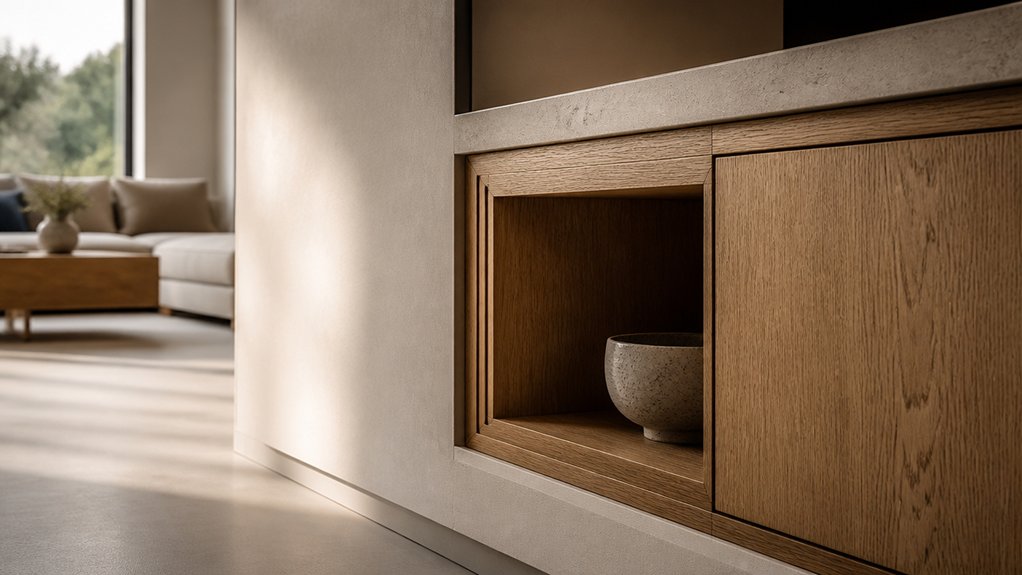
When you control the gaps as intentionally as the joints, reveals and shadow lines make traditional joinery read sharp and contemporary. Set consistent reveals at cabinet ends, toe-kicks, and panel intersections so the eye reads intentional geometry, not tolerance drift. Use dark backers or paint the recess to deepen the line; keep widths repeatable with story sticks and spacers.
Plan reveals and shadow lines around door swing and seasonal movement: leave room at meeting stiles, and align vertical reveals with adjacent wall joints or tile grids. Then refine with edge profile detailing—ditch heavy roundovers and pick a small chamfer, arris break, or crisp quirk to catch light.
On benchtops, undercut edges for floating shadows while keeping your joinery honest.
Choose Woods That Suit Contemporary Spaces
To keep traditional joinery feeling current, you’ll get the cleanest read from light, neutral timber tones that bounce daylight and soften hard edges.
You can reinforce that modern calm by choosing boards with straight, quiet grain and minimal figure, so your shadow lines and reveals stay crisp.
You’ll also want sustainable species—FSC-certified oak, ash, or plantation-grown alternatives—so the build signals modern values as clearly as modern detailing.
Light, Neutral Timber Tones
Because light, neutral timber reads as calm rather than “country,” it’s the easiest bridge between crisp modern lines and traditional joinery details. You keep the room feeling architectural while letting pegs, haunches, and shoulders read as intentional craftsmanship, not ornament.
Start with ash, pale oak, maple, or birch, and specify a clear matte finish that won’t amber over time. You’ll get a Neutral palette that pairs cleanly with microcement, stainless, and soft whites, yet still warms flat planes.
Ask your maker to bookmatch panels or align Timber grain through stiles and rails so the geometry stays sharp. Use lighter tones on large surfaces—cabinet runs, wall lining, benches—then echo them in small joinery accents to keep the whole scheme coherent.
Clean-Grain Wood Selections
Light, neutral tones set the backdrop, but the grain you choose decides whether the joinery reads crisp and contemporary or busy and rustic.
Aim for a tight, even grain pattern—think rift- or quarter-sawn oak, straight-grained ash, or clear maple—so mortise-and-tenon shoulders and miters look sharp, not chaotic. You’ll get cleaner shadow lines, calmer panels, and a quieter match to minimal hardware.
Check figure before you mill: cathedral grain across wide faces can fight modern symmetry, so reserve it for secondary surfaces or bookmatch it deliberately.
Prioritize wood durability where hands land—table edges, stair rails, cabinet fronts—by selecting stable stock, consistent density, and minimal knots.
Seal with matte, low-build finishes to keep pores readable and the craft honest.
Sustainable Species For Modernity
Two choices make sustainable joinery feel unmistakably modern: pick species with a low-impact supply chain, then match their color and grain to the clean geometry of contemporary rooms.
Start with FSC-certified oak or ash when you want crisp pores that read architectural under matte oil. Choose maple or birch for pale, gallery-like planes that sharpen shadow lines in reveals and chamfers.
If you’re chasing warmer minimalism, specify thermally modified pine or poplar; the treatment boosts stability for tight miters and seamless flush doors.
Ask your mill about Eco friendly harvesting and document chain-of-custody on invoices. Prioritize renewable timber sources with short transport distances, then standardize board widths so your panels align with modern grids and shadow gaps.
Match Finishes to Modern Color Palettes
To make traditional joinery feel at home in a modern scheme, you’ll coordinate wood tones with today’s palettes—warm whites, muted clays, inky charcoals, or soft greiges—so the grain reads intentional, not accidental.
You’ll balance sheen with purpose: matte and rubbed finishes keep things calm and contemporary, while a controlled satin can highlight crisp profiles without looking glossy.
You’ll also tune color temperature and undertone so stained or oiled surfaces stay consistent across adjacent pieces, even under changing daylight and LEDs.
Coordinate Wood Tones
Where do wood tones go wrong in a modern-traditional mix? You let every timber compete—warm oak beside cool walnut, or blotchy stain that muddies grain patterns and wood coloration.
Start by reading your palette’s undertone: if your walls lean blue-gray, steer toward cooler, smoked, or fumed species; if they lean greige or clay, favor honeyed, amber, or chestnut notes.
Then pick one “anchor” wood for large surfaces (floors, built-ins) and keep secondary woods within a tight value range, differing more in figure than color.
Sample boards under the room’s lighting, and check end grain too—joinery exposes it.
If contrast is needed, make it intentional and repeat it.
Balance Sheen And Color
Even if your wood tones line up, a mismatched sheen can still make a modern-traditional room feel “off”—glossy trim reads builder-basic against matte walls, while dead-flat cabinetry can dull crisp joinery details. Dial in surface sheen first: modern palettes tend to favor soft matte, satin, and low-luster oils that let profiles and handwork cast clean shadows.
Then tune color harmony by sampling finishes against your paint, stone, and metal—especially under evening light.
- Use satin on casings and doors to echo contemporary walls without losing edge definition.
- Keep built-ins one sheen level lower than adjacent trim so joinery stays intentional, not loud.
- Match undertones: pair warm oak oils with greige, and cooler stains with crisp whites or charcoal.
Seal with a consistent topcoat so touch-ups blend.
Set Rail/Stile Widths, Reveals, and Spacing
Because modern rooms tend to amplify every line and shadow, you’ll want to lock in rail and stile widths, reveals, and spacing before you cut a single joint.
Start by choosing a consistent face-frame or door proportion that suits the room’s scale: slimmer members read contemporary, while slightly wider ones nod traditional. Keep widths repeatable across the run to support crisp joint detailing.
Next, set reveals with feeler gauges or story sticks, not eyeballing. A tight, uniform 2–3 mm reveal looks current and highlights craftsmanship, but only if your spacing accuracy holds through finish buildup and seasonal movement.
Mark reference edges, mill to final thickness, then dry-fit and measure diagonals.
Finally, plan hardware clearances and end conditions so gaps stay even at corners, scribed walls, and filler strips.
Design Modern Cabinet Fronts and Panels
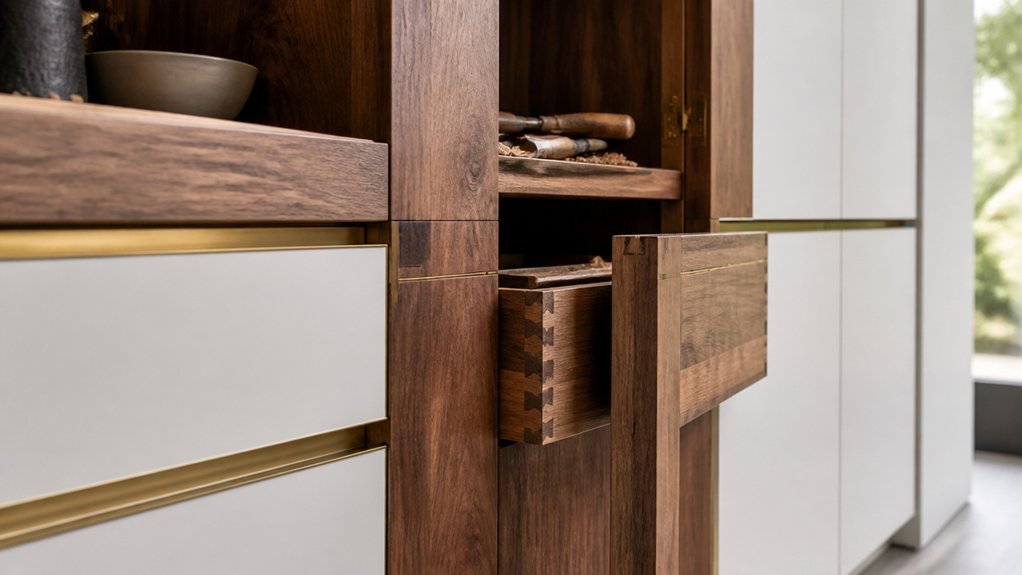
You’ll keep cabinet fronts feeling modern by choosing a minimalist door profile—flat slab, micro-shaker, or a tight frame-and-panel with crisp inside corners.
You can sharpen the look with smart material and finish pairings, like rift-sawn oak in a matte clear coat against painted fronts or a super-matte laminate for high-touch zones.
Then you’ll control panel proportion and rhythm by repeating consistent widths and alignments across runs, so the joinery reads intentional, not busy.
Minimalist Door Profile Choices
When you’re aiming for a modern interior that still respects traditional joinery, minimalist door profiles give you the cleanest path forward. You’ll get crisp planes that let your craftsmanship—tight shoulders, accurate reveals, and disciplined grain alignment—do the talking without ornate distractions.
Choose profiles that simplify the read while staying buildable with classic methods: cope-and-stick, frame-and-panel, or slab-on-core with solid lippings. Prioritize proportion, then tune the gaps so everything feels intentional and calm.
- Square-edge Shaker with a narrow rail for subtle depth
- Flush inset doors with consistent 2–3mm reveals for Furniture integration
- Slim shadow-reveal pulls or finger channels, balancing grip and Acoustic considerations
Keep hinge placement precise and match panel thickness to your carcase so doors sit dead-flat.
Material And Finish Pairings
Bridging crisp contemporary lines with time-tested joinery, your material and finish pairings set the tone before anyone notices a reveal or rail width.
Start with stable cores: rift-sawn oak or walnut veneers on ply keep panels flat while letting mortise-and-tenon doors read authentic.
For a modern edge, pair clear matte topcoats with wire-brushed texture, or specify a catalyzed lacquer in soft white to sharpen shadow lines without looking plastic.
Add Vintage accents through fumed oak, cerused grain, or an oil-wax finish that highlights ray fleck.
If you’re integrating Decorative carvings, keep them shallow and let a dark glaze sit in the cuts, then wipe back to preserve crisp geometry.
Finish hardware in burnished brass or blackened steel to bridge eras.
Panel Proportion And Rhythm
Although modern cabinet fronts often read as flat planes, panel proportion and rhythm quietly control whether the work feels intentional or improvised. You set the tone by sizing stiles and rails with discipline: keep margins consistent, align reveals to adjacent doors, and let negative space act like a frame.
When you mix slab fronts with framed panels, use Traditional joinery—mortise-and-tenon, bridle joints, or tongue-and-groove—so the geometry stays crisp as seasons move. Build cadence across a run by repeating divisions, then breaking them once for emphasis, like a well-placed seam.
- Choose a dominant module and repeat it across doors and drawers
- Vary only one dimension per bank to avoid visual noise
- Add Decorative carvings sparingly, confined to one focal panel
Choose Hardware That Sharpens the Look
How do you make crisp, modern lines play nicely with traditional joinery? You choose hardware that edits the silhouette, not competes with it. Start by matching your joinery’s intent: exposed dovetails pair well with slim edge pulls, while mortise‑and‑tenon doors read cleaner with recessed finger pulls or low‑profile levers.
Keep finishes deliberate: matte black and brushed nickel feel current; unlacquered brass adds warmth without looking fussy. Use hardware accents to echo your shadow gaps and panel reveals—consistent backset, tight alignment, and repeatable spacing matter.
If you want character, limit decorative hardware to one focal element, like a statement knob on a bar cabinet. Then size everything to your stile widths so proportions stay sharp.
Allow for Wood Movement With Proper Tolerances
When you pair tight, modern reveals with traditional joinery, wood movement becomes the detail that makes—or breaks—the crispness. You’ve got to design for seasonal shifts, not fight them, because wood expansion will telegraph as proud edges, split panels, or shadow lines that drift. Set joint tolerances intentionally, then hide the insurance inside the craft.
- Float panels in frame‑and‑panel doors, and ease the grooves so the field can breathe.
- Use elongated screw slots, figure‑8 fasteners, or Z‑clips to secure tops without locking grain.
- Orient grain to minimize cross‑grain conflict, and leave micro‑gaps at end grain returns and scribed fillers.
You’ll keep the look razor‑clean while the structure quietly adapts over time, with fewer callbacks and cleaner seams.
Conclusion
When you blend modern restraint with traditional joinery, you’re designing calm spaces that still show the maker’s hand. Let your clean cabinet fronts, disciplined rails and stiles, and crisp shadow-line reveals do the talking, then finish with hardware that reads like punctuation. Remember: wood’s alive—build in tolerances, not hope. *Especially*, building studies estimate 30–50% of a home’s heat loss comes from drafts and gaps—tight joinery isn’t just prettier; it performs.
About the Author