- Key Takeaways
- Why Choose a Marble Fireplace?
- Practical Considerations and Drawbacks
- Selecting the Perfect Marble
- Modern Design and Integration
- The Installation Process
- The Ethics of Stone
- Conclusion
Key Takeaways
- Marble fireplaces provide an unbeatable combination of aesthetic appeal, lasting quality and practical heat conduction to increase your daily comfort and impressively raise your home’s cachet. With their inherent veining and color variances, no installation is like the other. They serve both as a heating element and as a timeless architectural statement.
- Buyers must weigh marble’s elegance against its functional constraints, particularly its porosity and susceptibility to stains, scratches, and certain cleaning chemicals. Scheduling routine sealing, careful upkeep, and mindful placement near high-traffic or messy areas preserves the surface for years to come.
- Selecting the appropriate marble type, finish and format impact both functionality and aesthetics. Therefore, comparing popular types, considering polished or honed finishes, and choosing between slab or tile based on your budget, maintenance preferences and design objectives is key. By matching the stone to the home’s overall aesthetic — from minimalist to traditional — you have a more cohesive interior.
- With modern design strategies such as minimalist profiles, traditional carved surrounds and bookmatched veining, marble fireplaces can work in a variety of interiors, from modern apartments to classic homes. Incorporating smart control over fuel type, flame height and temperature can optimize comfort and efficiency without compromising the stone’s personality.
- Professional assessment and installation are critical because marble fireplaces can be heavy, structurally demanding, and sensitive to heat and fuel type. Working with qualified contractors to evaluate supports, flue requirements, sealing, and finishing methods reduces safety risks and helps the fireplace perform well over the long term.
- Conscientious homeowners and designers now think about the ethics of stone, including sourcing transparency, quarrying impacts, and environmental footprint. By seeking origin documentation from suppliers, favoring certified or lower-impact sources, and exploring sustainable alternatives as suitable, a marble fireplace venture can harmonize with wider environmental and social aspirations.
===
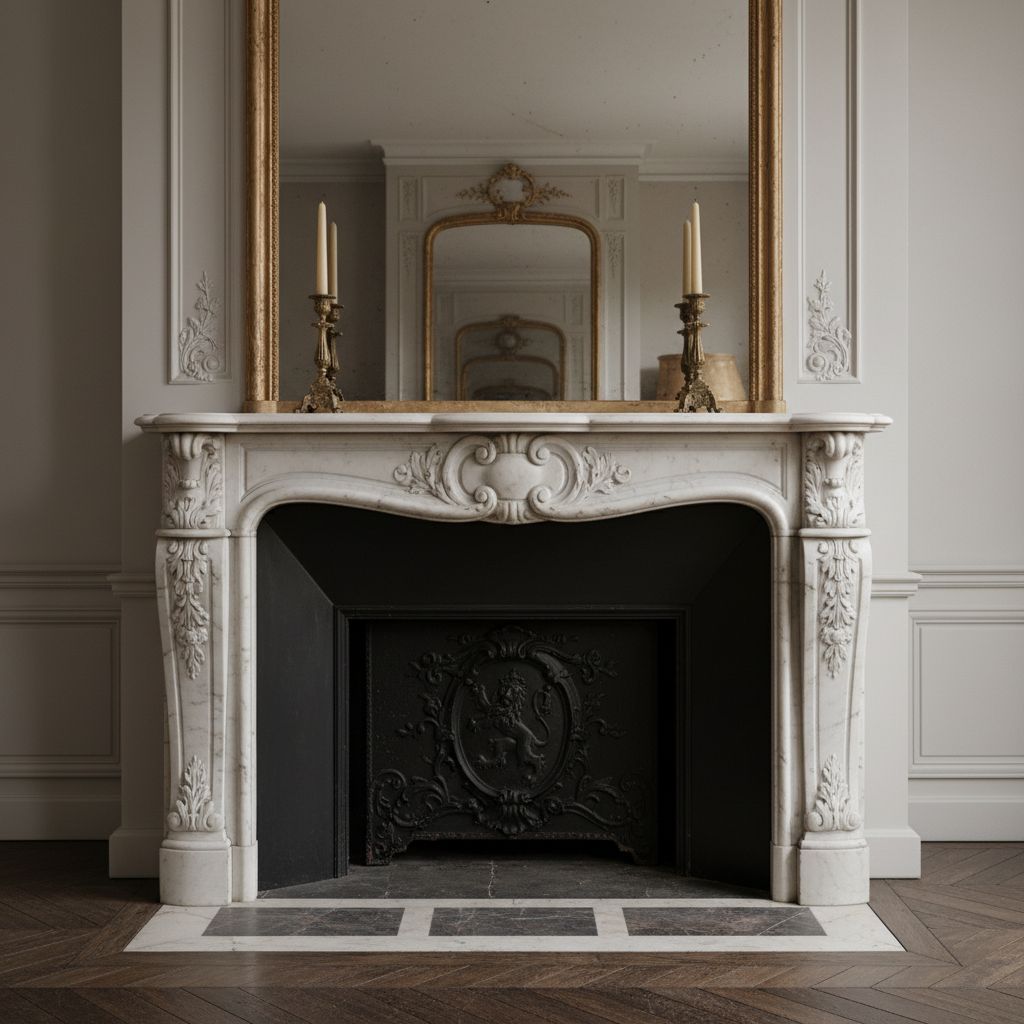
A marble fireplace is a fixed-hearth structure constructed of natural marble used for heat, as a visual focal point and as an element of interior design.
Marble is a popular choice among homeowners for its clean lines, long wear and variety of colors and veining. Many people use it to ground living rooms, bedrooms or open-plan areas.
To plan properly, cost, safety codes, heat output, weight and maintenance requirements are key considerations and they’ve informed the following sections.
Why Choose a Marble Fireplace?
A marble fireplace does more than frame a fire. It defines the ambiance of the entire room, the way people congregate and the way the space ages, both stylistically and functionally.
1. Unmatched Aesthetics
For decades, marble has been the unsung “gold standard” to anyone who desires a fireplace surround that says elegant without screaming it. There’s a natural depth to this stone that paint, metal, or fabricated panels can’t quite duplicate.
There’s nothing like watching the gentle swirls of veining drift across an expansive mantel or a soaring floor-to-ceiling surround to establish a defined visual core to the room. This carries through a lot of the interior styles.
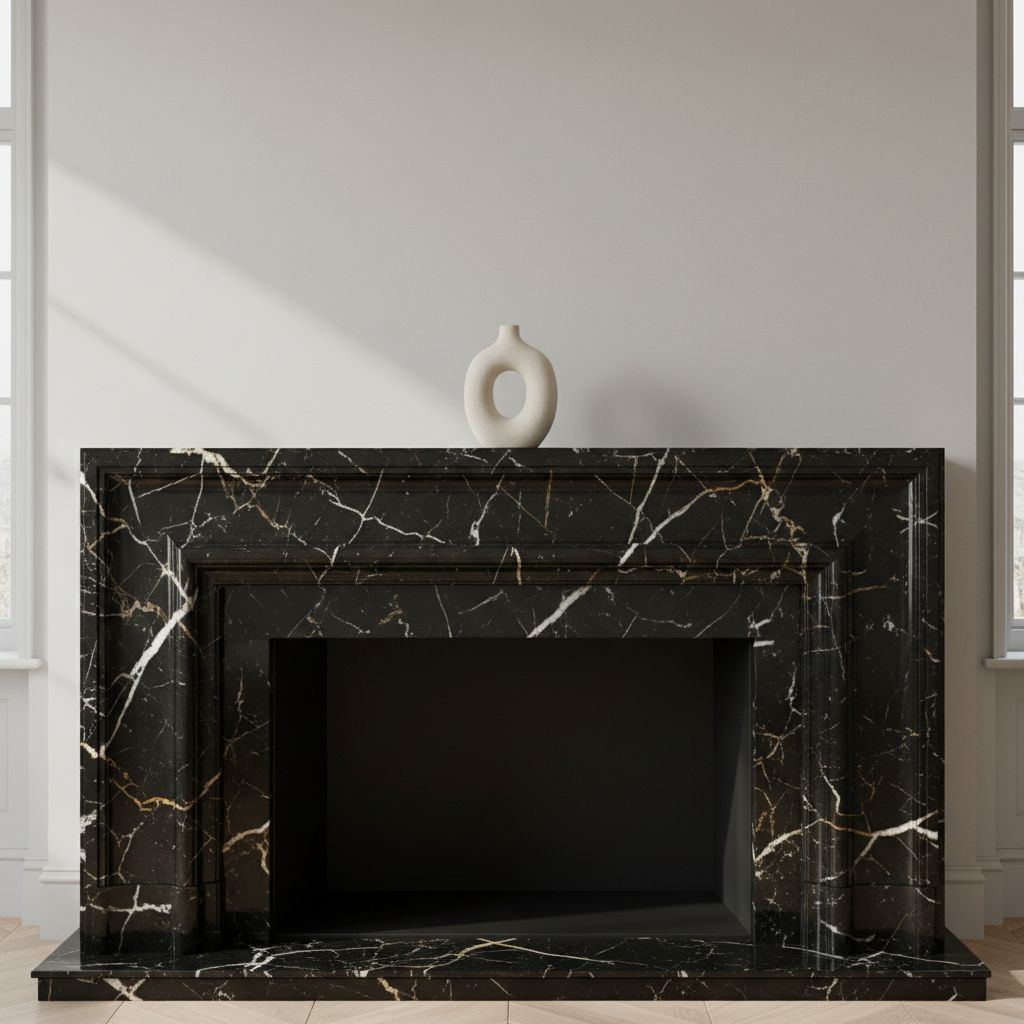
In a classic living room with moldings and framed art, a white marble with soft grey veining grounds a traditional aesthetic. In a small city apartment with clean lines and sparse decoration, a straightforward black or dark grey marble with a linear, boxy silhouette complements a modern setting.
That selfsame material can lean either way, which aids if your taste pronounces. Finishes add yet another level. A polished surface catches light and has a more formal touch, handy in rooms on the dimmer side or that moonlight as a home office or meeting space.
A honed, matte finish looks softer and hides tiny scuffs from decor objects. That spectrum makes marble a versatile option for those still defining their long-term aesthetic.
2. Superior Durability
Marble is a compact, hard stone, and a fireplace surround doesn’t encounter the same daily duress as a kitchen countertop. You’re not chopping, dropping pans, or spilling acids on it multiple times a day.
This lesser impact means that a marble fireplace can maintain its look for decades with just light mopping. Since the surround is predominantly vertical, dust and light soot clean off with a damp cloth and mild soap.
There is less chance of staining deeply. Even in houses where the fire is employed regularly during cold months, the primary ‘wear’ is aesthetic warmth, not physical harm, which is why countless older homes retain original marble surrounds in fine condition.
3. Excellent Heat Properties
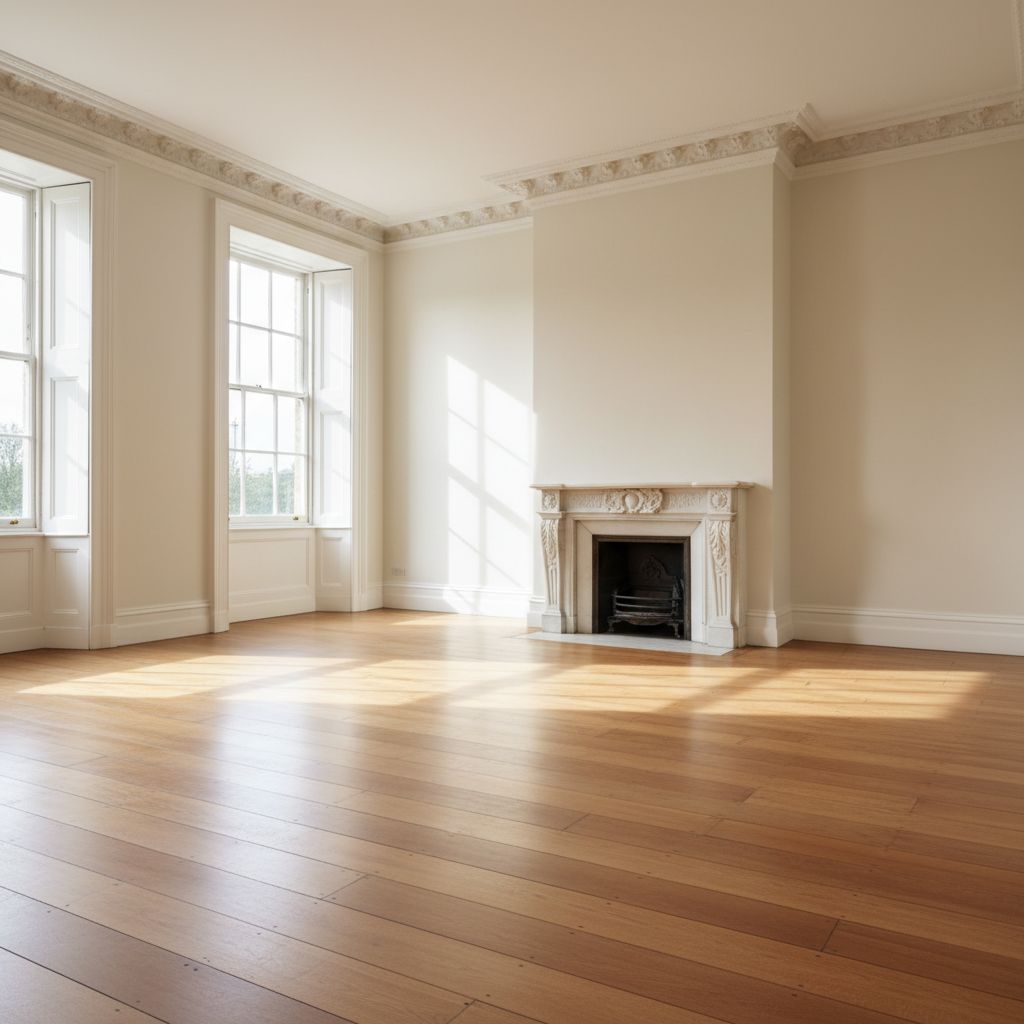
Marble is highly heat-resistant and non-combustible, which is why it is code-compliant in most fireplace applications. There’s no need for a gap; it can sit right on the firebox opening whereas wood trim or some composite materials require greater clearances to avoid warping, melting, or catching fire.
The stone further absorbs and radiates heat in a slow, steady manner. When the fire is going, the surface near the opening heats and then radiates that heat more slowly into the room, smoothing out temperature swings.
For gas, wood, or electric inserts, this steady temperament minimizes the possibility of spontaneous cracking or damage from everyday temperature fluctuations, assuming the unit is properly installed.
4. Increased Home Value
A stylishly designed marble fireplace tends to scream “high end” to buyers and renters. It suggests craftsmanship with materials in a primary living space, which can bolster top-line property value.
Since marble goes with just about everything, from classic townhomes to sleek lofts, it reduces the chance that your fireplace will feel old-fashioned in a few years. That universal appeal comes in handy if you’re looking to move, sublease a room, or just want the flexibility to rearrange and reinvent the space without having to replace the surround.
5. Unique Natural Artistry
Every marble slab is one of a kind. The veins, color transitions, and minute mineral patterns provide a fireplace surround with a unique texture that’s difficult to mimic with printed laminates.
This organic variation provides layers of depth, ensuring the fireplace remains captivating even when the flames are out and the room is still. We can select the veining patterns intentionally.
Linear veining fares well in minimalist interiors, where clean lines rule. Random or dense veining can really become a focal point in a larger room, almost like a built-in art piece. Light veining fits tranquil studies or bedrooms, where you prefer the hearth to enhance, not overwhelm, your concentration.
You have a say in how the slab is presented. Book‑matching, which mirrors the pattern on two pieces, can conjure an abstract, symmetrical image over the firebox, whereas one continuous swooping piece maintains a peaceful cohesiveness.
In all, the final product remains a silent piece of nature’s artwork that requires no additional decoration to feel whole.
Practical Considerations and Drawbacks
A marble fireplace may appear elegant and substantial. It introduces compromises in maintenance, expense, and durability that count if you rent, cohabitate, or relocate frequently.
Porosity Concerns
Marble, being a porous stone, drinks liquids and delicate soot. This means wine, coffee, or even dark smoke stains can seep below the surface rather than lingering on top where you can wipe them away. Acidic liquids like vinegar, lemon juice, and numerous popular cleaners don’t just stain; they actually etch, leaving dull spots that fragment the smooth polish surrounding the firebox opening or on the hearth.
Daily habits assist more than any “miracle” item. Dry dusting with a soft cloth or microfiber pad prevents ash and grit from behaving like sandpaper and scratching the face of the surround. Immediately wiping spills away with a damp cloth, then drying the stone, minimizes the possibility that moisture and pigments will fall into pores.
A quality stone sealer, applied every 1 to 2 years, provides a thin shield against soot, moisture, and light staining. It won’t eliminate the need for regular gentle cleaning and will wear faster in areas you rub or come into frequent contact with.
The Cost Factor
Marble fireplaces are typically at the upper end of the price range for surrounds and mantels, particularly when the design incorporates thick slabs, custom profiles, or rare stones. Top-end varieties like Calacatta and Statuario frequently command multiples of the price per square meter of more common marbles due to limited quarry supply and extremely high demand from luxury projects.
A simple surround in those stones can cost as much as an entire room of mid-range tile. Beyond the stone, you plan for precise fabrication and installation. Expertise for measuring, cutting, edge shaping, dry fitting, and safe mounting comes as an obvious line item.
Heavy slab transport requires coordination so pieces don’t crack at doorways or stairs. For a tiny city flat, it’s worth weighing a thin marble veneer over a structurally sound substrate versus a full depth carved mantel to find that sweet spot between appearance, weight, and cost.
Structural Demands
Marble is dense and heavy, so the wall and floor surrounding the fire have to support these concentrated loads without shifting. For older buildings or lightweight metal-stud walls, installers typically supplement with backing boards, steel brackets, or additional framing to distribute the surround and mantel’s weight, which adds time and cost.
If the hearth extends into the room, the subfloor underneath may require inspection and reinforcement so it doesn’t sag over time. Heat resistance is one of marble’s fortes, that doesn’t mean it’s impervious to thermal shock. Hard, quick temperature changes like a red-hot log slamming against a cold hearth edge can lead to small cracks or chips.
Proper clearances from the firebox, approved firebox inserts, and consistent moderate firing help keep stress lower on the stone. In everyday life, that translates to avoiding behaviors such as slamming metal fireplace implements down on edges or laying down super-hot items fresh from the flames onto the same spot repeatedly.
Finish Sensitivity
The finish of the marble surface dictates not only how the fireplace appears but how it ages in actual homes. Highly polished marble bounces light and can make a small living room feel luminous. It immediately shows etches, scratches, and streaks of soot, which can be nerve-wracking in shared or rental spaces where a lot of foot traffic goes through the room.
Honed or matte finish camouflages small marks better. Even these can reveal cup rings or slight discoloration around the firebox. Seal every 1 to 2 years for any finish type, but it doesn’t prevent the slow accumulation of fine dust, hair, and fingerprints that demand habit care.
Marble is cool and formal looking from a visual perspective, particularly white or gray. A big polished surround, along with high gloss floors or spare furniture, can tip a room toward a stark or too-formal ambience that doesn’t suit casual or eclectic aesthetics.
In small studios or shared flats, it can help disrupt the impact with softer textures—fabric, wood, or matte metal—so the fireplace seems like a component of a lived-in area, not a museum piece.
Selecting the Perfect Marble
Selecting marble for a fireplace is a compromise between appearance, maintenance, and price. The aim is to complement the stone to how you use the room, how much attention you will want to give it, and the decor of the rest of your home.
Popular Varieties
Most of you begin with Carrara or Calacatta, both traditional Italian marbles. Carrara is typically a light gray-white with soft, fine veins. It is a great choice if you desire a calm, quiet background that won’t compete with furniture or art.
Calacatta is typically a brighter white with thicker, more dramatic veins in gray, gold, or even taupe. It lends itself to a fireplace you want to read as a focal point on its own.
Veining is more important than a lot of buyers realize. Light veining melts into minimal, low-contrast interiors, like a white wall with pale floors. Medium veining provides interest behind a TV or bookcase without making the wall feel chaotic.
Bold veining can make the surround a statement piece in an otherwise simple living room with blank walls and an unassuming sofa.
The cut forms the ultimate design. With a vein-cut slab, lines run in one direction, giving the fireplace a strong linear flow that complements modern cabinets or low, linear benches. Cross-cut marble shatters those veins into gentler, swirling lumps that seem more natural and laid back.
Color range is wider than many expect: white, beige, gray, and warmer creamy options. A creamy Spanish marble with beige and light brown veining, for example, can warm up a cool gray room or connect dark wood floors and white walls without a stark contrast.
Polished vs. Honed
Polished marble has a reflective, mirror-like finish that accentuates color and veining, but reveals etches and fine scratches more readily on the face of the surround and hearth.
Honed marble is matte, so reflections are more gentle and marks are less pronounced. This is a boon in a bustling household or rental where you’re just looking for a steady, low-drama vibe as the years pass.
Both finishes are marble underneath, so both require routine cleaning with a soft cloth or damp microfiber cloth and pH-neutral stone cleaner. No acidic or abrasive products can etch or dull the surface even if the stone is sealed.
Slab vs. Tile
A slab fireplace employs big slabs, typically one or two huge slabs across the face and legs, providing you with invisible joints and the ability to book-match veins so that they reflect across the firebox like a folded page.
Tile installations fracture the surface into numerous joints, which can be a great cost savings and can help fit into tight spaces or complex shapes. You sacrifice some of the sweeping motion of the veining, and you introduce grout lines that require light maintenance.
In either case, the stone remains sturdy and non‑combustible, so it handles heat beautifully. The actual factors are stain hazard and maintenance.
Seal on install, then reseal every 6 to 12 months, testing yearly by dropping a few drops of water on an inconspicuous spot and observing how quickly they darken the surface.
For stain prevention, wipe spills quickly, place coasters and trivets beneath candles, plants and metal decor, and avoid harsh cleaners. Once an acidic stain or etch presses into a white marble face, repair can be expensive and may still leave a residual scar.
Modern Design and Integration
These state-of-the-art marble fireplaces exist at the intersection of craft, construction technology, and practical household utility. Design aspects today are more about clean lines, safe heat performance, and how the fireplace integrates zones in a house than a mere showpiece.
Minimalist Styles
Minimalist marble fireplaces eliminated superfluous trim and heavy ornamental features to emphasize simple geometry, proportion, and balance. A typical configuration is a long, linear fire box embedded in a broad marble slab, frequently with a very thin border of 10 to 20 millimeters, so that the flame line reads almost like a graphic stripe.
This works well for tiny city apartments, as it maintains a visually airy design while still providing a definitive anchor within the space. Neutral tones fare well here. White, grey, or beige marble with matte plaster walls or light oak floors keeps the space chill and simple to decorate.
Some designers like to throw in a band of textured stone or narrow wood ledge beneath the marble to break the smooth surface and add shadow lines so the fireplace feels warm instead of cold or “gallery like.” For the fire bed, gas and electric inserts tend to use river rocks, black glass, faux logs or lava rock.
A white marble surround with black lava rock provides sharp contrast, while tumbled river stones beneath a line of flame feel softer and more organic. The idea is to customize the aesthetic so it fits how you use the space—hard-hitting and sharp for a work-from-home living room, or cozier and more physical for a chill lounge.
Traditional Grandeur
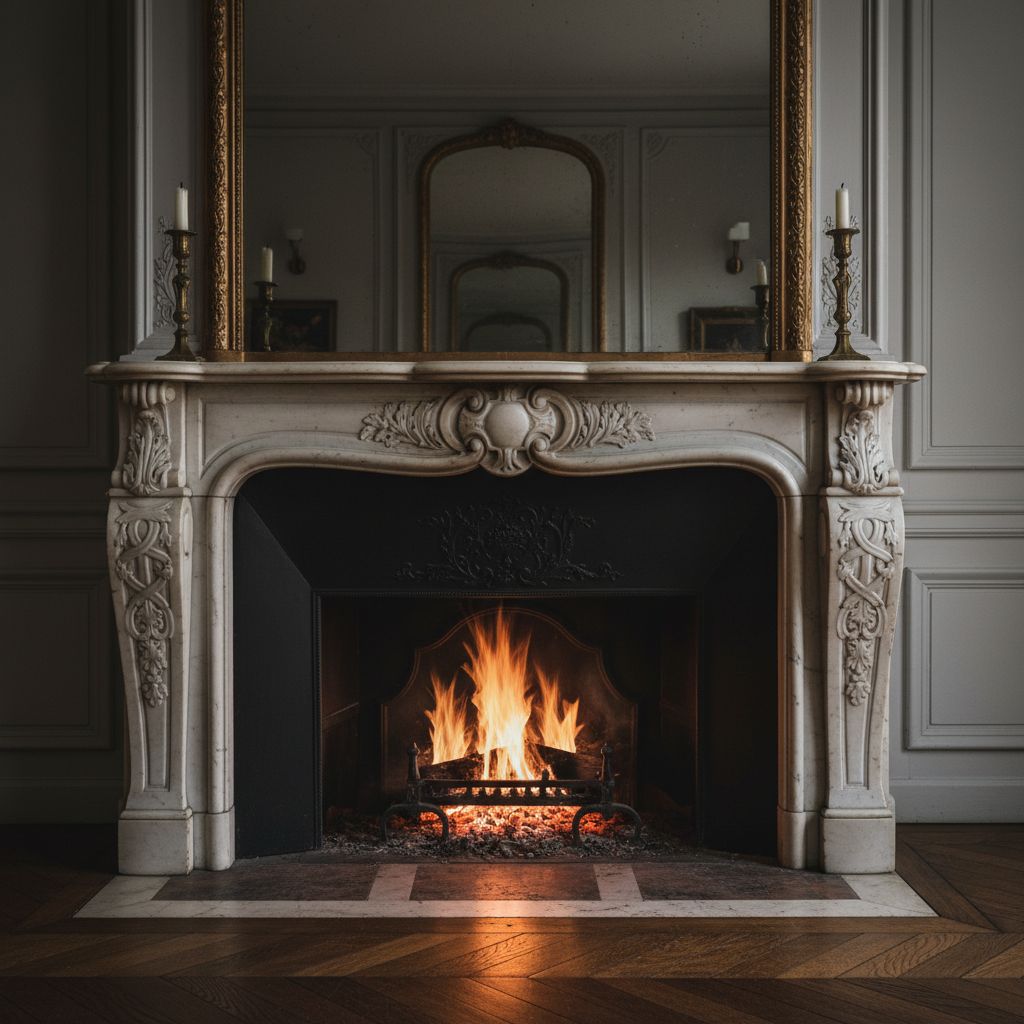
While traditional marble fireplaces still utilize larger mantels, carved legs and deeper hearths, modern integration keeps them from feeling like stage sets. One popular approach is to pair a traditional profile—say a French Louis style surround—with bare walls, low furnishings and concealed storage so the fireplace registers as one powerful historic note inside a minimalist container.
Almost floor-to-ceiling can frame a conventional opening, with the lower one to 1.2 meters in carved marble and the upper section in plaster, wood paneling, or large-format stone tiles. This mix allows you to maintain the feel of “grandeur” while still accommodating TVs, speakers, and lighting in a neat grid above.
Double‑sided wood or gas units compliment more formal mantel designs. For instance, a marble surround confronts the living room, while the back side toward the bedroom remains flat and minimal, perhaps in painted plaster. It connects public and private spaces, keeps both spaces warm and does not pit two competing ‘hero’ features against one another.
Bookmatching Techniques
Bookmatching utilizes two marble slabs cut from the same block and opened like a book so the veining reflects across a seam. On a fireplace, this is most commonly done vertically, with the seam running up the center of the firebox or horizontally, with the seam across the mantle line.
Since fireplaces are commonly observed from 2 to 4 meters away, the impact comes across as a bold graphic pattern, nearly on the level of abstract art. In reality, proper bookmatching requires meticulous slab selection and arrangement. Fabricators plot the vein flow so it doesn’t fight with the fire opening or TV niche.
Strong diagonal veining can “gesture” toward the fire, while soft clouds in a stone like Carrara generate a more subtle, restful appearance. Many designers utilize bookmatched marble on the main face and revert to plain cuts on the returns and hearth to keep cost in check while maintaining the impact.
Smart Technology
Smart integration primarily manifests in how you control and stoke the fire, while marble serves as the sturdy, heat‑resistant casing. Many gas and electric models now connect to apps or home systems where you can schedule, adjust flame height, or cap maximum temperature.
This is useful if you work late or want the room warmed up before you get up. Certain hybrid designs, such as the ones we own, are able to transition from gas to wood in as little as 30 minutes, employing modular grates and flue configurations.
Marble surrounds manage these transitions since the stone withstands heat and thermal cycling when installed with appropriate clearances and non-combustible backers. Intelligent layouts encompass spatial design. A four‑sided open fire with a marble base can anchor an open‑plan living‑dining zone, while a slim linear unit in a marble‑and‑wood wall can nestle under a TV without visual clutter.
Contrasts, such as warm wood next to cool stone or dark stone against pale marble, make the technology seem like it’s integrated into the architecture, not bolted on.
The Installation Process
Installing a marble fireplace is not as much of a gamble as it is a slow, careful installation. Every stage impacts security, durability, and how neat your final lines appear in your home.
Professional Assessment
A professional assessment starts with the basic question: can the existing wall and floor safely hold the weight of the marble mantel surround? An installer checks wall type (solid masonry, concrete, or framed studs), the state of the subfloor, and the size and mass of each marble piece. This matters because these surrounds are heavy and must be fixed by mechanical means into a solid structure, not only glued to drywall.
They check clearances to the firebox, the opening height and how the surround lines up with any existing hearth. That is where careful planning and measurement come in. Every leg, header, and shelf is measured against the wall, the firebox, and each other, down to a few millimetres.
For a lot of buyers this is when to tweak design decisions, like leg width or shelf projection, prior to any cutting. A thorough evaluation strategizes entry and workforce. Because the installation is usually a two‑person job, thanks to the weight and size of the surround, you map out lifting points, stone piece staging areas, and where tools and protection will rest in the space.
Structural Support
Installation work begins with locating or establishing secure anchor points. On framed walls, installers cut wood studs into smaller blocking pieces, typically no longer than about 150 mm (around 6 inches), and insert these between studs at the intended anchor points. This blocking provides a solid, trustworthy foundation so screws can draw the marble snug to the wall without decompressing drywall.
Masonry walls support can be provided by expansion anchors drilled into brick or concrete at regular intervals along the legs and header line. In both, the objective is to distribute the load, so the weight isn’t borne by one or two spots but a small matrix of fixings.
A level and tape measure remain in hand throughout to keep all anchor points aligned.
Fuel Type Impact
Fuel type influences a few minor but significant decisions in the install. For a wood-burning firebox, your surround must extend beyond the rigid clearance zones delineated by fire codes, and your structural fixings must accommodate increased thermal movement.
Gas inserts can have tighter dimensions but still require non-combustible contact at the opening. For electric units, heat is lower, and cable routing and access for service creeps into the planning. These variations influence how close the marble legs come to the aperture, how much room you allow for trim, and which sealants or backing boards are okay.
For instance, with gas or wood, many installers steer clear of any combustible shims near the firebox line and depend instead on mineral board or metal spacers.
Sealing and Finishing
Finishing begins long before the caulk is applied. Installers do multiple dry fits, sometimes three or more, positioning each leg and then the facing header without glue to check joints, reveals, and level.
Dry fit the facing header on top of each facing leg once installed to ensure a good fit and repeat until gaps and overhang are balanced. When the layout feels right, construction adhesive and wood screws are put to work together. Adhesive bonds the marble to the prepared backing, while screws driven through brackets or hidden plates with a power drill lock legs and other components to the frame.
We bring the level back out every time a screw is tightened, so the surround doesn’t twist or lean. Once the stone is set, we fill the joints and seal the marble surface with a compatible sealer to assist with stain and soot resistance.
We pull out, clean off edges, remove tape and then give it one final check to see if anything moved during curing.
The Ethics of Stone
The ethical chatter surrounding a marble fireplace focuses on how the stone is extracted from the earth, how it is extracted and sliced, and what to do when you desire the same serene, timeless aesthetic with less impact on folks and the earth.
Sourcing Transparency
Sourcing transparency means you know where the marble came from, under what labor rules and with which safety and environmental controls. For a fireplace that might occupy your living room for decades, this chain of custody is as important as the visual grain on the surface.
Demand quarry location, extraction practices, and third-party audits. A number of trusted vendors today share fundamental quarry information, employee safety guidelines, and evidence that they comply with regional wage and child labor legislation. When they can’t or won’t share this, that’s valuable information as well.
Marble has graced fireplaces for centuries in townhouses, villas, and public halls because it exudes a timeless and tranquil appearance that never dates. In classic New England houses, for instance, white or gray marble surrounds sit nicely with unpretentious moldings and old-fashioned woodwork, and they continue to meet contemporary safety requirements because natural stone resists high heat without cracking or staining.
Each slab has subtle variations in color, veining, and micro-pits, so each surround is one of a kind — not a repeat pattern. Understanding the human narrative behind that single rock allows you to marry aesthetics with simple ethics.
Environmental Footprint
The ecological imprint of a marble mantel involves quarrying, cutting, surface finishing and long-distance shipping, frequently by sea and truck for thousands of kilometres. Mining stone disrupts ecosystems and consumes large amounts of water for dust suppression and cutting.
Processing consumes energy too, particularly for polished surfaces. At the same time, natural stone is permanent and enduring. Marble, granite, limestone, and travertine can take high firebox heat without surface melting, warping, or rapid wear, so you skip the frequent replacement.
That durability dilutes the original footprint over multiple years. Minimal upkeep helps: unlike kitchen counters, a marble surround does not face acid spills or cutting, so it does not etch in normal use and needs only gentle cleaning and, at times, sealing.
Sustainable Alternatives
Green doesn’t necessarily mean ‘not stone.’ Granite’s color range is as wide as you want it to be — anything from deep black to mottled green or red — so you can coordinate with existing floors or furniture, not five out more than you need to.
Limestone and travertine provide a warmer, more textured façade that suits rustic or Mediterranean-style rooms, yet still withstands firebox heat. Their pliant face can obscure minor gouges instead of exposing each scrape.
Some folks shy from natural stone on account of price or fashion. Porcelain slabs can replicate marble veining via inkjet printing and employ thinner, lighter panels, reducing shipping weight. Soapstone offers a softer, matte finish and incredible heat resistance, which fits well with sleek, modern stoves and tight city apartments.
The aesthetic is more muted and it ages differently than marble. For all these options, the same questions apply: ask about recycled content, production energy, local sourcing, and expected lifespan, then match them to how long you plan to stay in the space.
Conclusion
A marble fireplace alters the energy of a room every single day. The stone brings heft, cool, and defined focus. A petite Berlin flat with a thin white marble surround gets hush-lit and reined in. A massive New York loft with dark veined marble gets extra depth, contrast, and a graphic edge.
A clever design considers heat thresholds, maintenance, and stain danger. A good scheme controls origin, quarry method, and lasting impact.
To get going, map out your room, record your heat habits, then consult a stone yard and an installer. Request to view actual slabs, not just samples, and discuss cost, care and ethics before you finalize your decision.
About the Author