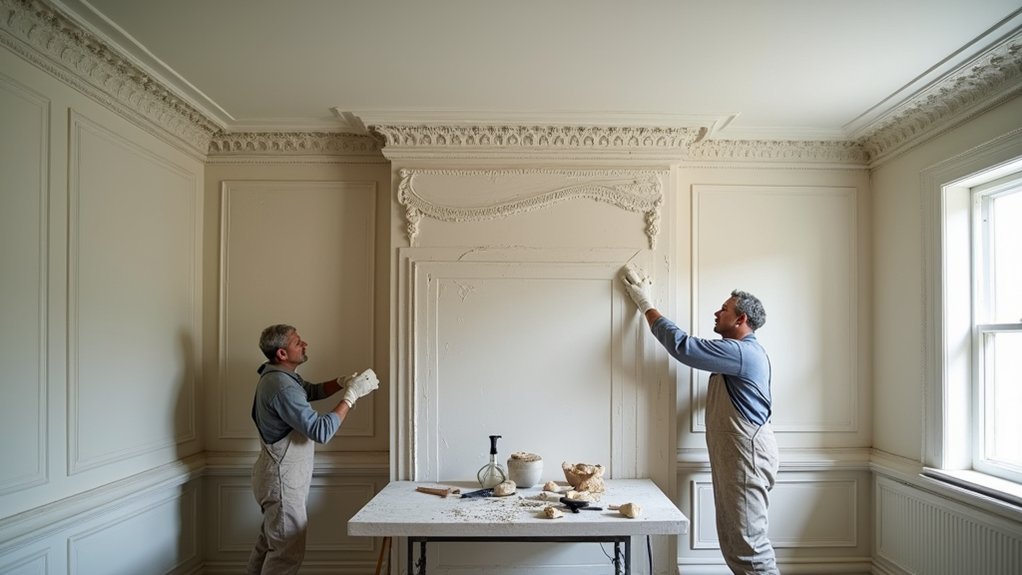
You’d think a few missing Victorian mouldings could ruin the whole room from cornice to skirting. You start by spotting what’s gone—dentils knocked off, egg-and-dart softened by paint, mitres hacked back after old wiring—then you bring in specialist plasterers who can take measured drawings, photos, and surviving fragments and run or cast lime-based replicas to the exact shadow line. The real test comes when new work meets lumpy, tired plaster…
Key Takeaways
- We surveyed missing cornices, roses, and rails, identifying damage causes like rewiring, skimming, and damp before specifying repairs.
- We documented profiles with photos and measurements, then sourced matching originals from salvage yards and pattern books to confirm authenticity.
- We hired specialist plasterers experienced in lime work, testing samples for crisp arrises, clean mitres, and accurate shadow lines.
- We chose repair, splice, or full replication based on bond strength and loss extent, using impressions and casting for missing enrichments.
- We planned access, preparation, and quality checks, allowing for irregular Victorian surfaces and ensuring stable substrates to prevent future cracking.
Which Victorian Mouldings Are Missing (And Why)
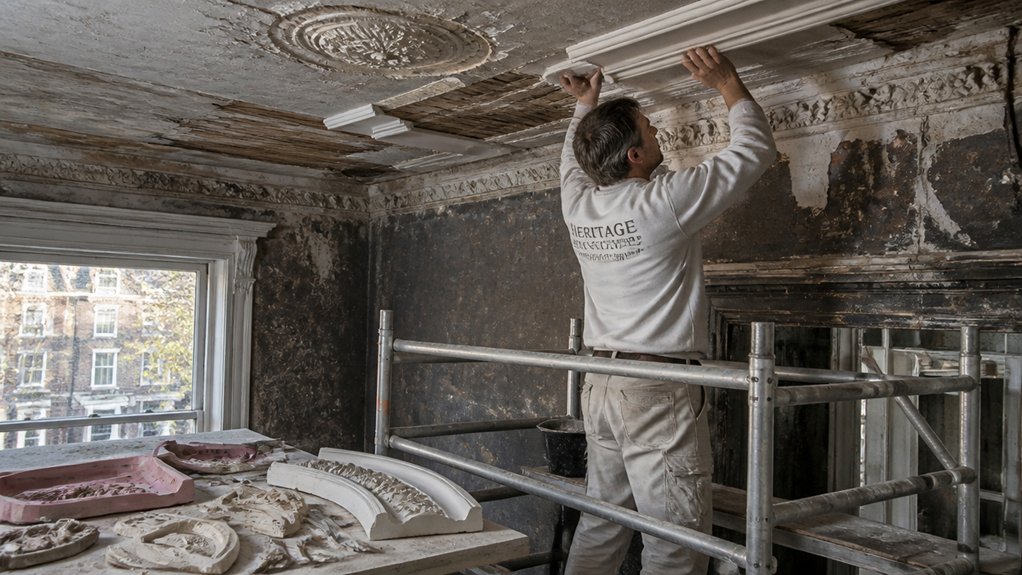
Although Victorian rooms were originally dressed with generous runs of plasterwork, the mouldings you’ll most often find missing today are the finer, high-maintenance details—picture rails, ceiling roses, dentil or egg-and-dart cornice enrichments, and the deeper cove-and-step profiles that took time to run and skill to mitre.
You’ll notice they vanish where redecorators stripped paper, skimmed ceilings, or lowered heights for services. Electricians often hacked out roses for pendants, then patched flush. Later cornice repairs got simplified because stop-ends, returns, and enrichments cost labour and demanded sharp running moulds.
Moisture and movement also take their toll: hairline cracking at mitres, blown keys on lath, and salt contamination around chimneys. If you’re chasing Victorian ornamentation and historical accuracy, you must read the room’s scars like evidence.
Repair, Replace, or Replicate: What to Choose
Before you order new cornice or let someone skim over what’s left, decide whether the existing moulding can be repaired in situ, needs a like-for-like replacement run, or warrants a full replication of the original profile and enrichments. You’ll make the call by checking bond, loss, and legibility of detail, then weighing Historical accuracy against Material durability.
- Repair when the core’s sound: consolidate friable edges, re-pin loose lengths, and fill chips with fine casting plaster, then re-run small sections off a short horse.
- Replace when runs are missing or de-bonded: cut back to firm arrises, splice new lengths, and marry junction lines cleanly.
- Replicate when enrichment’s gone: take a crisp impression, cast ornaments, and re-run the full profile for faithful shadow lines.
Where to Find Original Victorian Moulding Profiles
To match a Victorian cornice or ceiling rose properly, you’ll want a true profile to work from, not a modern “close enough” sketch. You can often source originals through salvage yards and architectural reclamation, where you inspect crisp arrises, run lengths, and the tell-tale gauge of laths and casting.
When the yard comes up short, you’ll turn to archive catalogues and period pattern books to pin down the exact ogee, cyma, or enrichment before you set out your running mould.
Salvage Yards And Reclamation
When you’re trying to match an existing cornice, ceiling rose, or picture rail, salvage yards and architectural reclamation dealers give you the closest thing to a Victorian pattern book in the flesh. You’ll find runs cut from demolished terraces, odd lengths with soot-stained arrises, and roses with crisp leaf tips that modern casts rarely replicate.
Take a vernier, shoot square-on photos, and note projection, drop, and any enrichments so your plasterer can lift a faithful profile with restoration techniques and historical accuracy.
- Ask for provenance: street, date, and room position.
- Check condition: cracks, soft lime, paint build-up, repairs.
- Buy samples: short runs, corners, and ceiling junctions for templating.
Archive Catalogues And Pattern Books
Salvage gives you physical samples, but archive catalogues and Victorian pattern books let you pin down a profile even if the original run’s gone. Start with the RIBA Library, the V&A National Art Library, and local record offices holding builders’ merchants lists and architects’ specs.
You’ll often find cornice “sections” drawn full-size, with projection, drop, and enrichments named, so your plasterer can set out a match without guesswork.
Ask for late-19th-century catalogues from firms like Jackson & Sons or George Jackson; their plates show ogees, astragals, and dentils in standard runs. Cross-check against your room’s ceiling height and bay geometry for Historical accuracy.
Then tie it to Material sourcing: specify lime, hair, and hessian where the book assumes traditional gauged work.
How to Choose Plasterers for Victorian Mouldings
Although plenty of competent plasterers can run a straight cornice, Victorian mouldings demand a specialist who understands lime work, sharp arrises, and the exact profiles typical of the period. You should interview firms that can talk through Restoration techniques and prove historical accuracy with measured drawings and site references, not just glossy photos.
Ask what they’ll do when ceilings are out of level, walls bellied, or original grounds are missing—good hands plan repairs before ornament.
- Request close-up samples showing crisp undercut, clean mitres, and consistent gauge.
- Check they’ll match lime:aggregate ratios and use hessian/scrim where movement’s expected.
- Insist on a method statement covering substrate prep, moisture control, and protected setting times.
If they can’t name common Victorian profiles, keep looking.
Bespoke Victorian Mouldings: Cast vs Run in Situ
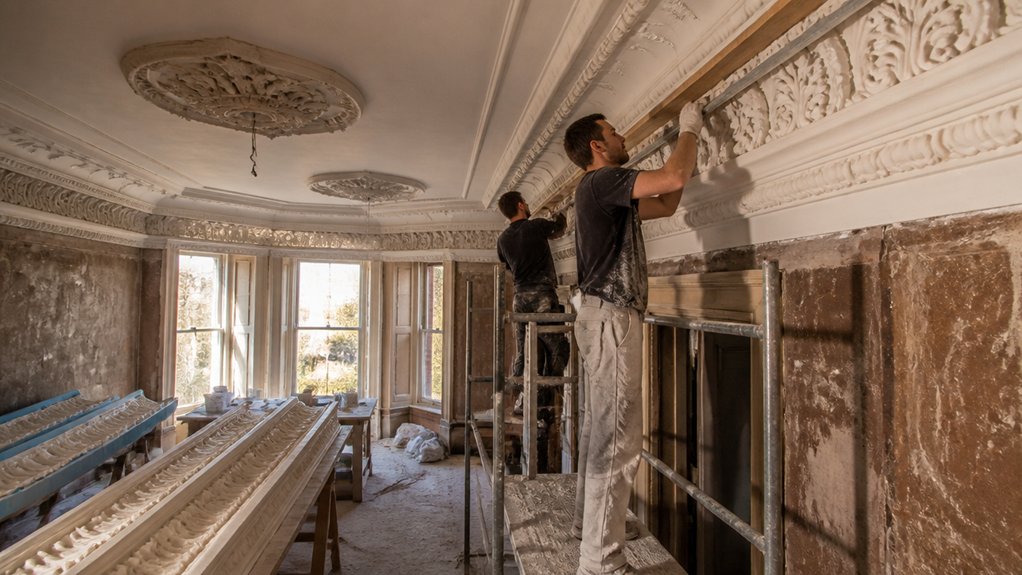
Why choose between casting and running in situ for bespoke Victorian mouldings? You’re balancing access, profile complexity, and finish, while protecting Historical accuracy.
Cast work suits repeated enrichments—egg-and-dart, dentils, ceiling roses—taken from a sound sample or carved pattern, then poured in fine casting plaster. You can bench-cast lengths for straight runs, keep joints tight, and install once the substrate’s ready.
Running in situ suits continuous cornices and deep coves where the profile must read as one line; you fix a running mould to a horse, gauge plaster to the right set, and pull successive passes to crisp arrises.
Your material sourcing matters: choose lime-rich mixes for older fabric, and match aggregate and hair where specified by survey and sample.
Blending New Mouldings Into Old Plasterwork
When you splice fresh Victorian mouldings into existing work, you’re not just filling a gap—you’re matching the old plaster’s line, hardness, and surface so the repair disappears under raking light. You start by cutting back to sound arris and undercutting the edge, so the new work keys without a proud seam.
Keep Historical accuracy by reading the profile’s shadow: the fillet width, ovolo sweep, and tiny flats that machines often soften. Then you tune Material durability by gauging the mix to the substrate—lime-rich to breathe on old laths, harder gypsum only where the background can take it.
- Scratch-key the join and dampen to control suction.
- Butter with fine stuff, press, pin, and align off a straightedge.
- Feather, rule, and sand lightly so tooling marks match.
Victorian Mouldings Cost: What Drives the Price (And Mistakes)
You’ll see Victorian mouldings costs shift with the stuff you specify (lime, gauged plaster, fibrous) and the profile’s richness—deep undercuts, egg-and-dart, and tight returns all push rates.
Labour follows suit once you factor run lengths, mitres, setting times, plus access and prep like lath repairs, stabilising loose backgrounds, and working over high ceilings or stairwells.
Most pricing mistakes come from under-measuring waste and junctions, skipping prep allowances, or assuming modern skim-ready walls when the house needs proper period-compatible making good.
Materials And Profile Complexity
Although two mouldings might look similar from the floor, their price can diverge sharply once you factor in the material and the profile’s complexity. You’ll feel it most when you choose between fibrous plaster, lime putty runs, timber, or modern polymer: each behaves differently, takes detail differently, and ages differently. Material durability matters in a damp cornice line or a busy stairwell where knocks are inevitable.
- Base material: lime and gauged plaster suit breathable Victorian fabric; dense gypsum gives crisper arrises but can crack if the substrate moves.
- Profile intricacy: deep undercuts, egg-and-dart, and leaf enrichments demand sharper tooling and more robust moulds.
- Scale and repeats: larger projections and tight repeats increase casting waste and finishing time.
Labour, Access, And Prep
Because Victorian cornices and centre roses rarely sit on square, clean ground, labour often eclipses the cost of the moulding itself. You’ll spend hours reading the room: bellied laths, hairline movement, soot-blackened plaster, and old distemper that won’t take adhesion.
Before any run goes up, you must rake out loose edges, key back to sound work, and set gauges for true lines that still respect period irregularities.
Access drives time. High ceilings mean scaffold, hop-ups, and clear runs for mixing and lifting; tight stairs slow every carry.
Tool selection matters: margin trowel, small hawk, mitre box, running mould, and sharp scrapers for rebates.
You can’t skip Safety precautions—lead paint checks, dust control, eye protection, and secure platforms.
Costly Pricing Mistakes
A common way Victorian moulding jobs go off the rails on price is by treating the profile as the main cost and the room as an afterthought. You’ll pay more when you ignore corners, mitres, ceiling roses, and awkward bays that slow setting times and force extra running.
- You under-measure: you price straight runs, then get hit by returns, chimney-breasts, and picture-rail breaks.
- You skip samples: without a take-off and trial cast, Restoration techniques turn into rework, waste, and call-backs.
- You “simplify” details: shaving leaves, beads, or coves might seem cheaper, but it wrecks Historical accuracy and triggers redesign, approvals, and re-running.
Price properly by mapping every junction, checking substrates, and allowing for drying, fixing, and fine filling.
Conclusion
When you bring back lost Victorian mouldings, you’re not just “tidying up” plaster—you’re restoring the room’s grammar: cornice, corbel, ceiling rose. You’ve weighed repair versus replica, traced true profiles from fragments and archives, and chosen plasterers who can run in situ or cast with crisp arrises, sharp mitres, and honest shadow lines. Done well, new work disappears into old—like a seam you can’t find, only feel.
About the Author