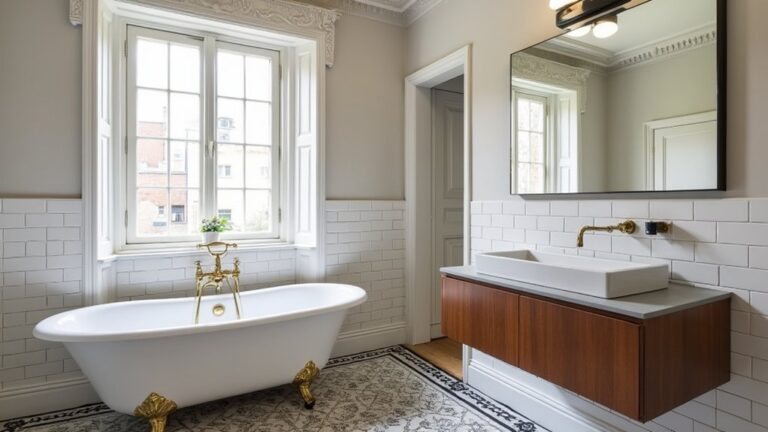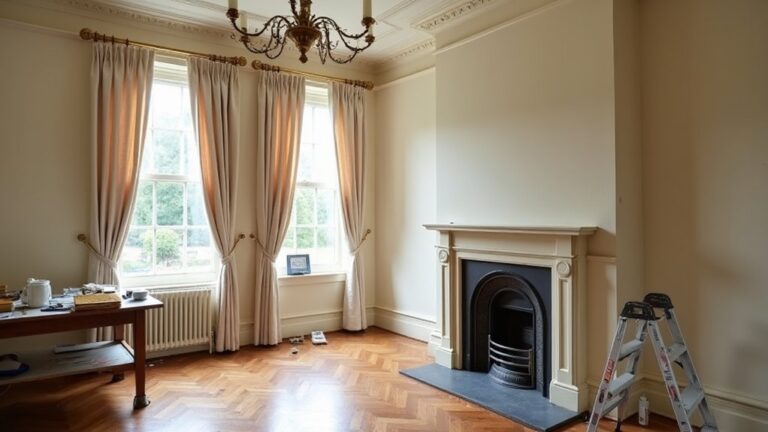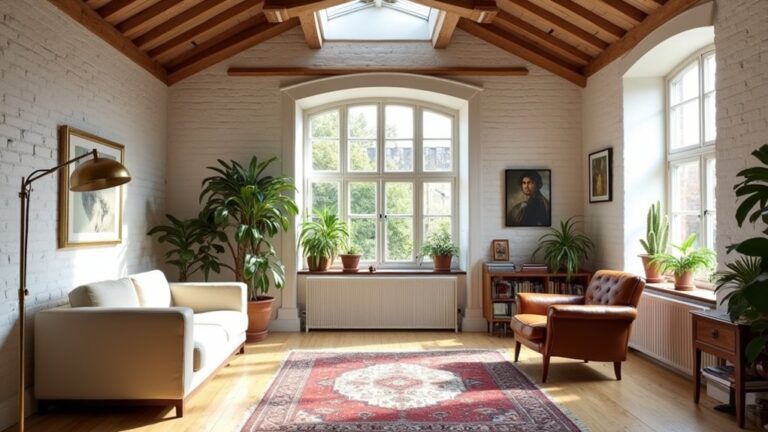
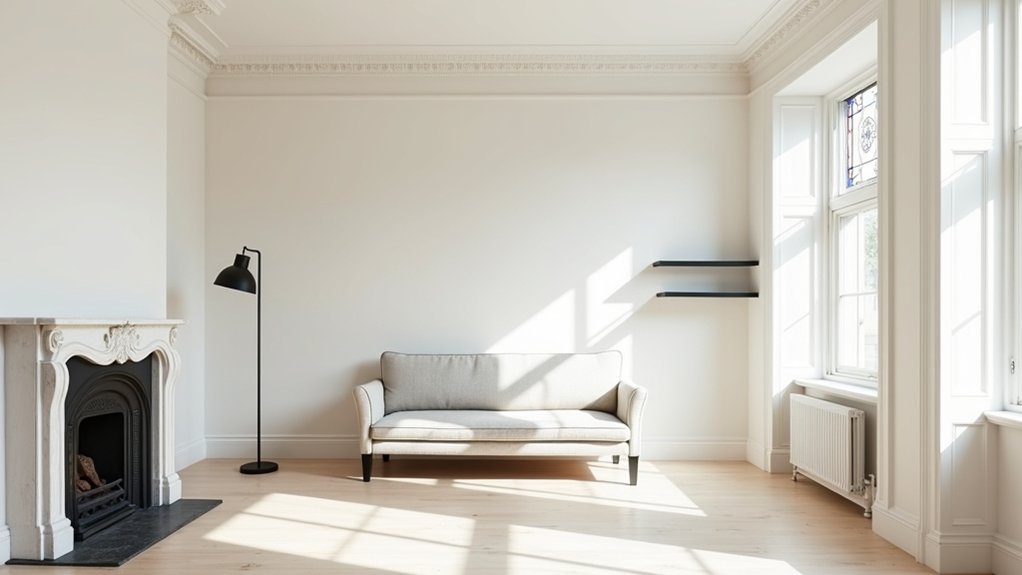
You can blend Victorian character with minimalist restraint by deciding what’s structurally worth keeping, then controlling everything else—palette, materials, lighting, and clutter. Start with original cornices, ceiling roses, sash windows, and fireplaces, because in UK terraces these details set the room’s hierarchy. Then strip back wall treatments, tighten your joinery lines, and plan furniture to suit the generous proportions. Get that sequencing wrong and the space feels either sterile or fussy… which is where the next steps matter.
Key Takeaways
- Audit original features, preserve craftsmanship, and choose one “hero” element per room, usually the chimney breast, removing cluttering add-ons.
- Set a restrained Victorian palette: chalky off-whites, warm greys, muted greens; keep undertones consistent, using matte walls and eggshell trims.
- Simplify details with streamlined mouldings and subtle ceiling roses, then finish walls smoothly with flat plaster and low-sheen paint for crisp transitions.
- Plan spacious layouts with fewer, larger pieces; use slender-legged tables and flush-front storage, keeping clear circulation and visual breathing space around ornamentation.
- Layer warm 2700K high-CRI lighting to graze textures, and control clutter with disciplined surface styling: 60/30/10 composition and contained accessories.
Choose Which Victorian Features to Keep
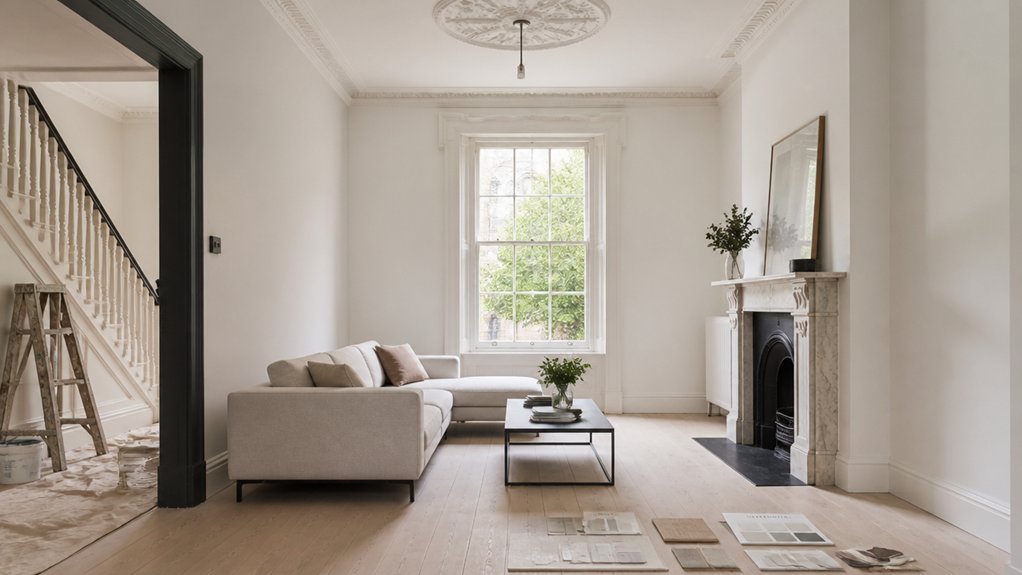
Although Victorian interiors can feel overwhelming once you strip back to minimalist essentials, you don’t need to erase the period to achieve restraint—you need to curate it.
Start by auditing what’s original and structurally legible: ceiling roses, cornices, fireplaces, sash windows, and stair balustrades. Keep elements that define proportion and craft, then remove add‑ons that clutter sightlines.
Prioritise one “hero” feature per room—typically the chimney breast with its surround—so Victorian ornamentation reads intentional, not busy.
Repair rather than replace; in UK terraces, retained joinery can improve value and conservation compliance. Where intricate woodwork survives, edit around it: strip back redundant picture rails, cap exposed services, and rationalise fittings.
You’re aiming for fewer, higher‑quality period notes, not a full score.
Set a Minimalist Victorian Palette and Materials
You’ll set the tone by anchoring the scheme in a neutral Victorian palette—chalky off-whites, warm greys, and muted heritage greens—so original cornices and ceiling roses read crisp rather than fussy.
Keep the material language authentic but edited: pair restored timber, encaustic tile, and aged brass with contemporary finishes like honed stone, limewash, and low-sheen paint for UK light levels.
Neutral Victorian Color Palette
A neutral Victorian palette works best when you anchor it in warm, UK-typical off-whites and stone tones—think chalky cream, putty, greige, and soft taupe. Then control contrast with inky accents used sparingly.
Keep undertones consistent: in north-facing rooms, favour warmer creams to offset cool daylight; in south-facing rooms, dial back yellow with greige.
Use matt finishes on large planes to minimise visual noise, and reserve a subtle eggshell for trims to sharpen period joinery without shouting.
When you introduce Victorian patterns, limit them to one scale per room and keep the background near your wall tone. This lets Modern color schemes read calm, while still respecting cornices, ceiling roses, and original fireplaces.
Modernized Heritage Materials
Once your neutral Victorian palette sits in place, lock it in with materials that echo heritage craft but behave like Modern finishes. Specify lime plaster or clay paint for breathable walls in UK solid-brick terraces; they level light softly and reduce condensation risk.
Pair them with honed limestone, slate, or terrazzo floors, sealed with low-sheen finishes to keep glare down.
For joinery, choose FSC oak or walnut in matt oil, then simplify profiles: square-edged skirtings, flat-panel doors, and concealed hinges. Use Heritage craftsmanship where it counts—restored cornices, ceiling roses, or a repaired timber sash—while upgrading performance with double glazing where permitted.
Introduce antique accents sparingly: aged brass pulls, reclaimed encaustic tile inserts, or a single marble hearth, kept crisp by minimal detailing.
Simplify Mouldings, Ceiling Roses, and Wall Finishes
You’ll get the cleanest minimalist-Victorian balance by specifying streamlined moulding profiles—think a plain ogee or shallow cove rather than deep, ornate sections common in UK terraces.
Keep ceiling roses subtle and correctly scaled to the room and pendant, so they read as heritage detailing without becoming a focal point.
Pair them with crisp wall finishes such as flat plaster and a low-sheen matt, keeping junctions sharp and colour breaks intentional.
Streamlined Moulding Profiles
While Victorian rooms often rely on layered cornices, heavy architraves, and ornate ceiling roses, a minimalist-Victorian blend works best when you strip those profiles back to their essential geometry. You’ll keep period intent, but lose visual noise by reducing steps, beads, and ornamental carvings to one crisp chamfer or a shallow ovolo.
In UK terraces, measure existing projections so new runs sit cleanly against uneven plaster, then specify consistent shadow gaps for a disciplined read.
- Choose a single-profile cornice and match architraves to its radius, not its ornament.
- Replace fussy decorative trim with flat-faced boards and a fine quirk line.
- Finish walls in dead-matt paint; caulk joints, then sand for seamless gradations.
Subtle Ceiling Rose Choices
Because ceiling roses sit at eye-line when you look up, they can either anchor a minimalist‑Victorian room or drag it back into fussy pastiche, so specify one with disciplined geometry and shallow relief.
Choose a flat saucer, concentric ring, or pared‑back acanthus with crisp edges, avoiding deep undercuts that cast busy shadows under UK pendant lighting.
Keep diameter proportional: roughly 10–15% of room width, or just wide enough to mask the ceiling junction box and flex outlet.
If you’ve retained decorative cornices, match the rose’s projection to the cornice’s bottom step so the ceiling reads as one plane.
Specify fine ornamental plaster or GRP in heritage properties to reduce weight, then demand tight mitres, sharp arrises, and a seamless skim at the perimeter.
Clean Wall Finish Pairings
Once you’ve disciplined the ceiling rose and cornice line, lock the scheme in with wall finishes that read clean at UK viewing distances and under diffuse daylight. Keep mouldings slim: a 12–18mm square-set shadow gap or a shallow picture rail is enough to signal period without visual noise. Choose one wall sheen and hold it consistently room to room so trim, plaster, and joinery feel intentional.
- Plaster and paint: Use well-skimmed plaster; specify durable matt (2–5% sheen) to hide raking-light defects common in terraces.
- Wainscot control: If you panel, run it to dado height and paint it the wall colour, not contrast.
- Softening layers: Add Vintage textiles, then limit ornate accessories to a single focal wall.
Plan Layout and Minimalist Furniture for Victorian Scale
If you plan the layout to respect a Victorian room’s generous proportions, minimalist furniture won’t read as sparse—it’ll look intentional.
Start by plotting circulation: keep 900–1,000mm clear routes between doors, bay windows, and seating zones, and centre groupings on the room’s primary axis.
Use fewer, larger pieces rather than many small ones; a low-profile sofa and one substantial armchair will scale better than a cluster of side chairs.
Maintain visual breathing room around cornices and ceiling roses so Victorian ornamentation stays legible.
Choose slender-legged tables and storage with flush fronts to sharpen Modern furniture contrasts without fighting architraves.
In UK terraces, align rugs to floorboards and keep radiators unobstructed for heat performance.
Make the Victorian Fireplace a Clean Focal Point
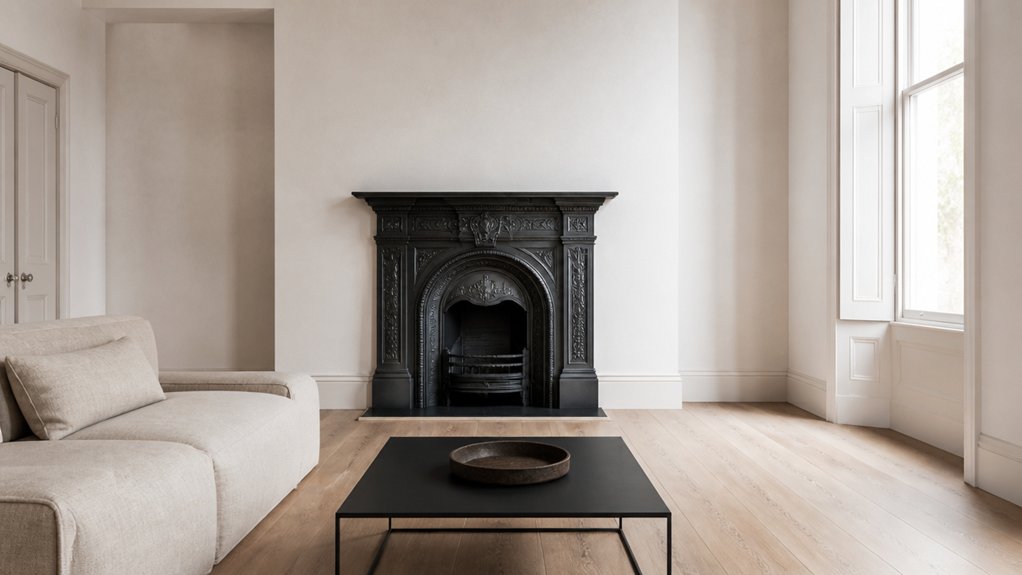
After you’ve set circulation and scaled back the furniture count, let the Victorian fireplace take over as the room’s anchor. Keep the surround original where possible, but control visual noise so the historic mass reads crisp against Modern simplicity.
If you’re in a UK terrace, check the chimney breast for damp and failed pointing before you dress the opening; a clean hearth line only works on sound substrate. Treat Victorian ornamentation as the feature, not the backdrop. Do this with disciplined edits:
- Strip the mantel to one low, matte object, centred and scaled to the frieze.
- Refinish cast iron with heat‑resistant blacking; keep tiles in muted tones.
- Use a plain fender or none; align the hearth edge with floor joints.
Choose Lighting That Highlights Victorian Details
Although minimalist schemes often default to recessed spots, you’ll get a stronger blend by using lighting to pick out Victorian texture—plaster cornices, ceiling roses, chimney-breast detailing and tile relief—without adding visual clutter.
Specify warm 2700K LEDs with high CRI (90+) so lime plaster, encaustic tile and aged timber read true, not flat.
Use slimline wall washers or discreet track with narrow-beam (15–25°) heads to graze mouldings; keep fittings matt black, white, or aged brass to suit Victorian architecture.
Add a single statement pendant on the ceiling rose, but choose a simple opal globe or linen shade to stay within minimalist lighting.
Put accents on dimmers and separate circuits for layered control.
Avoid cool light; it kills depth.
Style Shelves and Surfaces With Strict “Less, but Better” Rules
Once you’ve used warm, high‑CRI light to reveal cornices and tile relief, keep shelves and surfaces equally disciplined so the room doesn’t tip into period clutter. Treat every horizontal plane as display-grade, not storage, and edit weekly. Limit Decorative accessories to one material story per zone—brass, cut glass, or ebonised timber—so Victorian richness reads intentional, not busy. Keep ornate textiles off tabletops; use them where they perform: a single cushion, a Roman blind, or reupholstered chair seat.
- Set a 60/30/10 rule: 60% clear surface, 30% functional items, 10% curated accents.
- Use negative space: 5–8cm gaps between objects, aligned to skirting and picture rails.
- Contain smalls: one lidded box, one tray, one vase per room.
Conclusion
You strip back the clutter, yet you end up noticing more: cornices read sharper, ceiling roses feel grander, and a Victorian fireplace looks positively modern. You’ve kept the right features, fixed a matte neutral palette, and let restored timber sit beside contemporary finishes without fuss. With furniture scaled to the room, negative space does the heavy lifting. Then you add discreet, layered lighting—ironically proving restraint’s the best way to show off.
About the Author